Cycle Aware Freediving Training
Why cycle-aware training deserves a place in the freediving conversation
81% of women in a recent survey, have never spoken to a coach about how their menstrual cycle affects their training or performance.
In a sport built entirely on body awareness, that number feels like a significant gap.
I'm not sharing this to make anyone feel guilty. Coaches aren't to blame for a conversation that sport, science, and culture have collectively avoided for a long time. But I do think freediving, of all sports, has the potential to do better. Because the whole point is that we listen. To our breath, our body, our edges. It seems strange to stop short of this one.
Here's something that gets said a lot in freediving: there are no bad dives, just information. I love that reframe. But it only works if we actually have access to the information. If a diver is in their luteal phase, feeling anxious, cold, getting early contractions and a sluggish breath-up, and nobody has ever told them that could be cycle-related, they don't have information. They just have a confusing day and, often, a harsh inner critic to fill the gap.
I know, because that was me.
A story I heard during my research stayed with me. An athlete kept telling her coach that her menstrual cycle was affecting her freediving training. He told her it was psychological. I keep thinking about how that must have felt. To know something is happening in your body, to try to name it, and to be dismissed. How much trust does that cost? How differently might she have trained if she'd felt believed?
The conversation matters not just for women, but for everyone who dives alongside them, teaches them, buddies with them. We never dive alone. Understanding what might be affecting someone's state on a given day, even broadly, makes us better dive partners.
Cycle-aware training isn't about telling women when they can and can't freedive. It's not a restriction and it's not compulsory. Some women notice strong, consistent patterns across their cycle. Others don't. Both experiences are valid. The whole point is that you get to find out for yourself, without having to push through aimlessly. It can work in our favour, to alter our training an lean into the strengths that different cycle phases lend to us.
It starts with tracking.
After a few months of logging how you feel alongside your dives, patterns often start to emerge. Things like: around day 15 I feel sharp and confident, or: the week before my period, static feels harder and I get cold faster. Once you can see those patterns, you can choose what to do with them. Maybe you shoot for PBs when you feel strongest. Maybe you do breathwork sessions instead of depth work on the days your body's asking for rest. Maybe you just go a little easier on yourself when it's an "off" day, knowing it's not a reflection of your ability.
Adapting isn't weakness. It's just intelligent training.
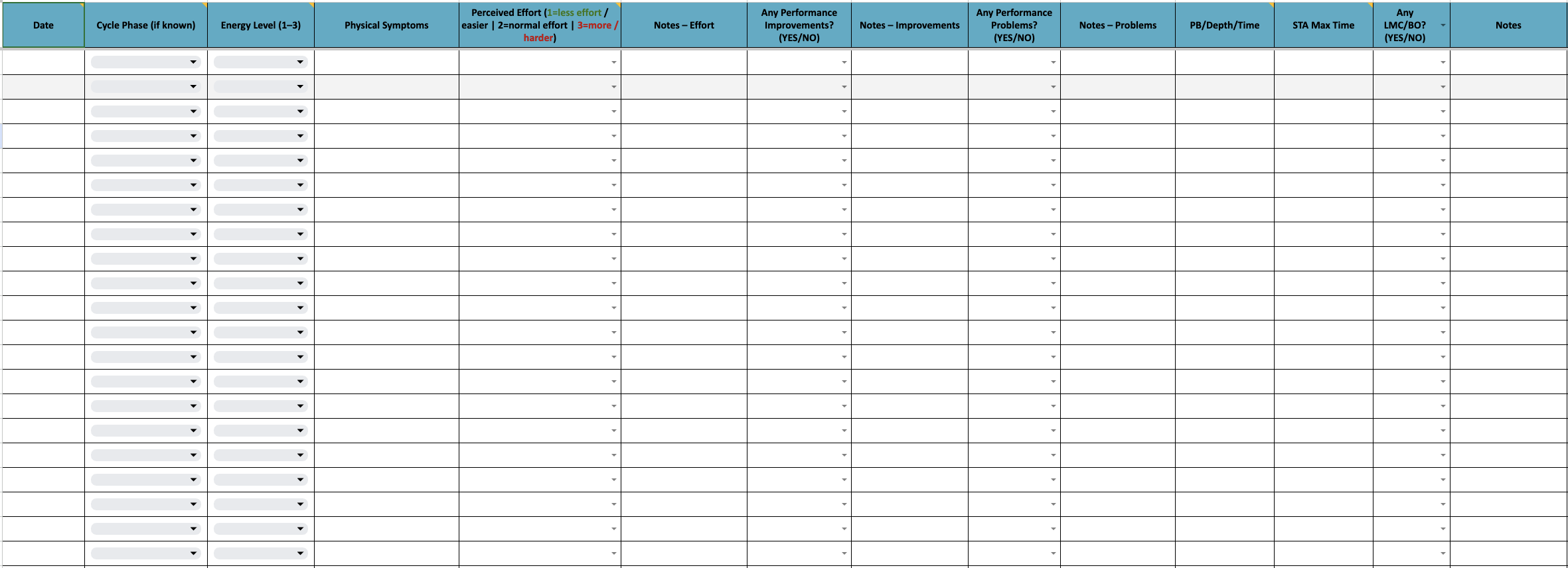
So, how can you train with your menstrual cycle?
I've created a free cycle tracking sheet that anyone can copy and use. It lets you log symptoms, energy, sleep, perceived effort, breath-hold comfort, contractions, equalisation, mindset, and anything else that feels relevant. There's no right or wrong way to fill it in. The idea is just to start noticing, without pressure, over time, then you can begin to spot patterns, and train in a way that aligns with them.
But at the very least, I hope this opens up a little more room for women to say "this is how I feel today" without it feeling awkward. That kind of culture in freediving, I think, benefits everyone.
👉 Access the free cycle tracking sheet here
Not a scientist, just a freediving instructor who got curious and started digging. All research shared in good faith, based on available evidence and the real experiences of women freedivers.
Want to know more?
Introducing my research project..