Menstrual cycle & freediving awareness guide
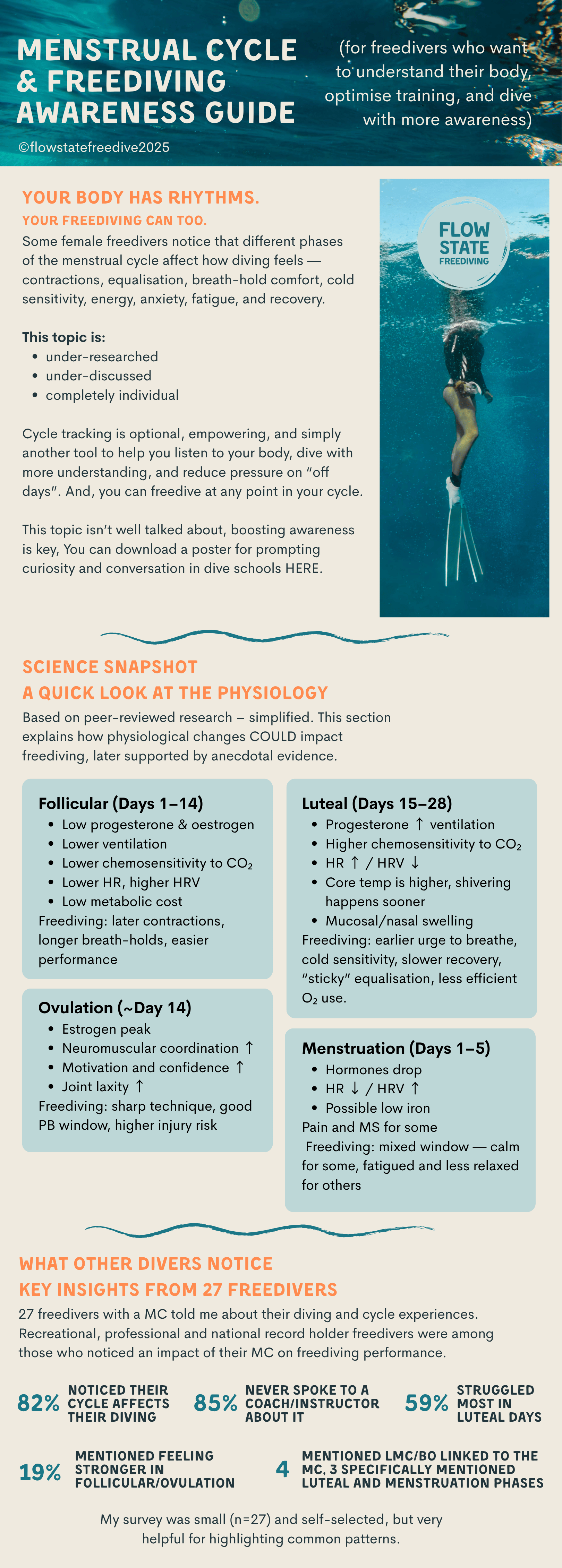
Here’s some findings based off my research into the topic of freediving and menstrual cycle phases, according to some peer reviewed papers.
The research on this is limited, and freediving-specific studies hardly exist. But when you take what we do know about how hormone levels shift across a cycle, and apply it to what freediving actually demands of your body, some patterns start to emerge.
During the luteal phase (the two weeks before your period), progesterone is high. Ventilation increases, baseline CO2 drops, and your body sits in a more activated, sympathetic state. For freediving, this can mean earlier contractions, a less comfortable urge to breathe, slower recovery between dives, and feeling the cold more quickly. Some women also notice equalisation feels stickier, and that stress or anxiety sits closer to the surface. During the follicular phase (roughly the first half of your cycle, after your period), hormones are lower and more stable. Ventilation drops, CO2 tolerance is higher, heart rate variability improves, and the body moves into parasympathetic tone more easily. For many divers, this feels like their clearest, most comfortable diving window.
What does that mean for you?
These are trends, not rules. The research shows enormous variation between individuals, and some findings are contradictory. One study even found longer breath-holds in the mid-luteal phase, possibly due to psychological comfort rather than CO2 physiology. Your cycle is yours. The goal isn't to follow a template, it's to start noticing your own patterns over time.
I've put together an infographic summarising the four phases and what each one might mean for your diving. Have a look above, save it, and start paying attention to where you are in your cycle next time you're in the water. In the next post, I’ll share some tools to help you track your cycle, and train in accordance with it.
1. FitrWoman / St Mary’s University / Strava survey — athlete–coach communication on menstrual cycle.
2. Herzberg SD et al., Am J Sports Med (2017) — ACL injury risk & menstrual cycle.
3. Hannah Klusmann et al. (2023) — cortisol reactivity higher in luteal phase.
4. Rattley CA et al. (2025) — ventilation increases in luteal.
5. England & Farhi (1976); Jurkowski (1981); Dutton (1989) — CO2 chemosensitivity changes across cycle.
6. Schmalenberger KM et al. (2020/24); Brar TK et al. — HR/HRV fluctuations.
7. Baker FC et al. (2020) — luteal rise in core temperature.
8. Hackney AC (1999) — metabolic cost & EPOC differences.
9. Sansores RH et al. (1995) — DLCO highest in late luteal, lowest during menstruation.
10. B Paulsson et al — nasal mucosal changes across menstrual cycle.
11. Belelli D & Lambert JJ — progesterone metabolites and GABA-A receptor modulation.
12. Cherouveim ED et al. (2020) — mid-luteal breath-hold longer than early follicular.
13. Samadi Z et al.; Mohebbi Dehnavi Z et al. — exercise reduces PMS symptoms.
14. Shagawa M et al. (2021) — increased joint laxity around ovulation.
15. Carmichael MA et al. (2021) — iron fluctuations during menstruation.